TonicNest may earn a commission if you buy through links on this page, at no extra cost to you. That does not change what we report.
Part of our Prostate 911 overview. Last checked October 27, 2026.
Does Prostate 911 work? Nobody can say, because no study has tested Prostate 911 itself, and the vendor's research page lists news items and cancer studies, none of them on the product[1]. Its best-known ingredient, saw palmetto, was compared with placebo in 27 studies with 4,656 men in a 2023 Cochrane analysis and made little to no difference to urinary symptoms[4]. Two other label ingredients have small, older trials that look better.
Does Prostate 911 work? The short answer
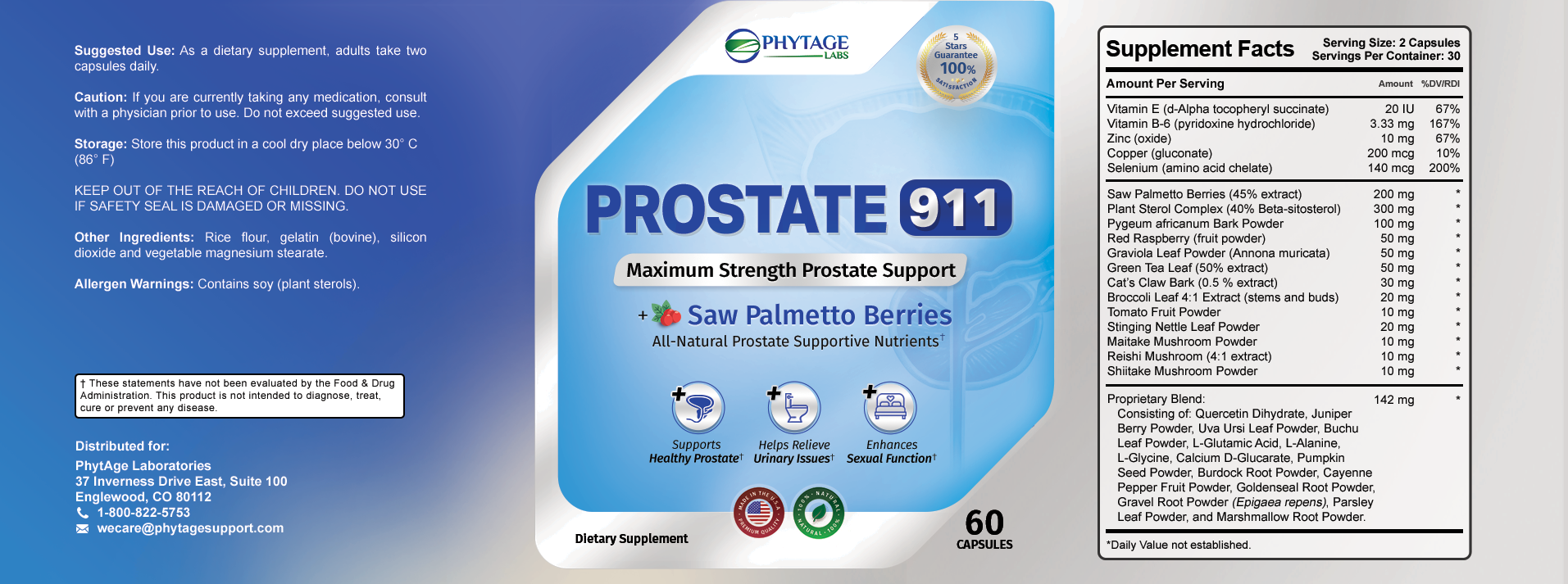
There is no direct evidence either way. Prostate 911 is a 2-capsule daily formula sold by PhytAge Laboratories through BuyGoods, and its label lists 200 mg of saw palmetto (45% extract), a 300 mg plant sterol complex that works out to about 120 mg of beta-sitosterol, and 100 mg of pygeum bark powder[2].
Those three have been studied for benign prostatic hyperplasia (BPH), the non-cancerous prostate growth behind many urinary complaints in older men. Saw palmetto did not beat placebo in the best trials[3]. Beta-sitosterol and pygeum showed modest gains in small, short trials from the 1990s and earlier[6][7].
What cannot be concluded: whether this exact mix helps you, whether the 142 mg proprietary blend of 15 more items adds anything, and whether results would last.
Which evidence levels should you not confuse?
Supplement marketing often blurs four different kinds of evidence. Only the last two tell you whether a product works, and Prostate 911 has neither.
Plausibility
A lab or animal finding gives a reason to test an ingredient. Many items in the Prostate 911 blend stop here. Buchu is one example: a 2022 review found only lab work and traditional use, with no human trials[13].
Ingredient trials
A randomized trial of one ingredient, at a set dose and form, in a defined group of men. Beta-sitosterol and pygeum reach this level. Their results apply to the doses and extracts tested, not automatically to a capsule that contains them.
Finished-product trial
A placebo-controlled trial of Prostate 911 capsules as sold. None exists. The vendor's research page cites no such study[1].
Replication
A second independent trial that finds the same result. Saw palmetto shows why this matters: larger NIH-funded trials, one at up to three times the usual dose, found no improvement in symptoms[3][5].
Prostate 911 claims vs what the evidence supports
The label and FAQ make several claims. Here is how each one holds up against the sources we checked on October 27, 2026.
| Vendor claim | Reasonable reading | Limitation |
|---|---|---|
| "Maximum Strength Prostate Support" (label) | Marketing wording | Saw palmetto is 200 mg; the CAMUS trial calls 320 mg a day the standard dose[5] |
| "Helps Relieve Urinary Issues" (label icon) | Some ingredients were studied for BPH symptoms | The product is untested; saw palmetto matched placebo[4] |
| "Enhances Sexual Function" (label icon) | No product data | None of the sources we checked measured this for Prostate 911 |
| Effects "within 7 days" (FAQ) | Timeline claim with no source | Beta-sitosterol trials ran 4 to 26 weeks[6]; pygeum trials averaged 64 days[7] |
| "as safe as a daily multi-vitamin" (FAQ) | Safety claim with no product data | The blend includes goldenseal and uva ursi, which carry drug and long-term use cautions |
| Cancer studies on the research page | Implies a cancer benefit | None tests the product[1] |
The vendor's FAQ also suggests a trial run of at least 90 days, again without a source[11].
Which ingredients matter most?
Three ingredients carry almost all the prostate evidence, and each has a mismatch between the label and the studies. The rest are 10 to 50 mg amounts or undisclosed shares of a 142 mg blend; see the full Prostate 911 ingredient list for each one.
- Saw palmetto, 200 mg. The label says "45% extract" without saying 45% of what[2]. Trials used 320 mg a day or more and still found no benefit over placebo[5].
- Beta-sitosterol, about 120 mg. This sits inside the 60 to 130 mg a day range used in BPH trials, the closest match on the label. The trials were few, small and short[6].
- Pygeum, 100 mg. Trials used standardized bark extracts, usually 100 mg a day. Prostate 911 lists bark powder, which is not the same thing[7].
- Stinging nettle, 20 mg. This is leaf powder. Prostate trials used root extract, one at 450 mg a day[8].
Population matters too. The saw palmetto trials enrolled men, mostly over 50, with moderate symptoms[4]. Results do not tell you what happens in men without BPH.
What results are realistic to expect?
Only the changes that trials measured, and only for the ingredients, not the product. In the Cochrane beta-sitosterol analysis of 519 men, symptom scores fell 4.9 points more than placebo and peak flow rose 3.91 mL/s over 4 to 26 weeks, with no change in prostate size[6].
Pygeum trials, averaging 64 days, reported 19% fewer night-time trips and 23% better peak flow[7]. Saw palmetto moved the 0 to 35 symptom scale (IPSS) 0.90 points at 3 to 6 months, which Cochrane rated as little to no difference[4].
None of these sources shows a supplement shrinking the prostate or lowering PSA. In CAMUS, saw palmetto left PSA unchanged even at high doses[12].
When should you see a doctor instead?
See a doctor before trying any prostate supplement if you have new urinary symptoms. NIDDK notes the same symptoms can come from bladder problems, urinary infections, prostatitis or prostate cancer[9], and MedlinePlus says to see your provider for them[10].
See a doctor right away if you:
- cannot urinate at all
- have urgent, painful urination with fever and chills
- see blood in your urine
- have severe pain in the lower belly[9]
Do not stop prescribed BPH medicine or skip PSA testing because you started a supplement. Our Prostate 911 safety and interactions guide covers the medicine questions.
Evidence conclusion
Prostate 911 combines one ingredient that failed in large trials, two with limited older support, and many small or hidden amounts. Here is the status as of October 27, 2026.
| Decision question | Current assessment |
|---|---|
| Has Prostate 911 been tested in a trial? | No |
| Does its saw palmetto beat placebo? | Not in Cochrane 2023 or CAMUS[4][5] |
| Is beta-sitosterol at a studied dose? | Yes, about 120 mg; evidence limited[6] |
| Is pygeum in the studied form? | No, bark powder rather than standardized extract[7] |
| Are all amounts disclosed? | No, 15 items share a 142 mg blend[2] |
| Can it replace a medical check? | No[9] |
If you still want to try it, check the refund terms on our Prostate 911 legitimacy check first. You can also read how we check products.
Back to the Prostate 911 overview.
Frequently asked questions
How long does Prostate 911 take to work?
The vendor FAQ says within 7 days, with no source. No trial of Prostate 911 exists. Studies of its ingredients ran 4 to 26 weeks for beta-sitosterol and about 64 days on average for pygeum, so a 7-day timeline has no support.
Has Prostate 911 been tested in a clinical trial?
No. We found no study of Prostate 911 itself, and the vendor research page lists news items and cancer studies rather than a trial of the product. Evidence exists only for some single ingredients, at doses and forms that do not always match the label.
Can Prostate 911 shrink an enlarged prostate?
There is no evidence it can. The Cochrane beta-sitosterol analysis found no reduction in prostate size, and the pygeum evidence does not show shrinkage either. Prostate 911 itself was never measured. Ask a doctor about proven options for an enlarged prostate.
Will Prostate 911 lower my PSA?
No source shows that. In the CAMUS trial, saw palmetto did not change PSA more than placebo even at high doses. Keep up the PSA tests your doctor recommends, and tell them about every supplement you take.
Is saw palmetto worth taking for BPH?
NCCIH says saw palmetto is probably not helpful for BPH urinary symptoms. A 2023 Cochrane analysis of 27 studies with 4,656 men found little to no difference from placebo, and higher doses in the CAMUS trial did no better.
Sources
- Scientific Research and Evidence. Prostate 911 vendor page, read October 27, 2026.
- Prostate 911 Supplement Facts label image. Prostate 911 vendor, read October 27, 2026.
- Saw Palmetto: Usefulness and Safety. NCCIH (NIH), read October 2, 2026.
- Serenoa repens for the treatment of lower urinary tract symptoms due to benign prostatic enlargement. Cochrane Database of Systematic Reviews, 2023, read October 2, 2026.
- Effect of increasing doses of saw palmetto extract on lower urinary tract symptoms (CAMUS). JAMA, 2011, read October 2, 2026.
- Beta-sitosterols for benign prostatic hyperplasia. Cochrane Database of Systematic Reviews, 2000, read October 20, 2026.
- Pygeum africanum for benign prostatic hyperplasia. Cochrane Database of Systematic Reviews, 2002, read October 20, 2026.
- Stinging nettle root extract trial in BPH (Karami 2020). PubMed, read October 2, 2026.
- Enlarged Prostate (Benign Prostatic Hyperplasia). NIDDK (NIH), read October 2, 2026.
- Enlarged Prostate (BPH). MedlinePlus, National Library of Medicine, read October 2, 2026.
- Prostate 911 FAQ. Prostate 911 vendor page, read October 27, 2026.
- Effect of saw palmetto extract on serum PSA (CAMUS analysis). Journal of Urology, 2013, read October 2, 2026.
- Buchu (Agathosma betulina and A. crenulata) review of pharmacology and traditional use. PubMed, 2022, read October 27, 2026.
This page is general information, not medical advice. Dietary supplements are not reviewed by the FDA for safety or effectiveness before they are sold and are not intended to diagnose, treat, cure or prevent any disease. Talk to your doctor before taking any supplement, especially if you are pregnant, nursing, take medication or have a health condition.